Schweizer Aufnahmen (1909-1923)
Schweizer Aufnahmen – Enregistrements Suisses – Ricordi sonori Svizzeri – Registraziuns Svizras
Swiss Recordings (1909-1923)
Edited by Jürg Fleischer, Thomas Gadmer, Ricarda Liver, Raphaël Maître, Mario Vicari and Linda Grassi.
Published by the Verlag der Österreichischen Akademie der Wissenschaften, Vienna, Phonogram Archives of the University of Zurich.
Description
The publication "Schweizer Aufnahmen" contains the oldest sound recordings of Swiss dialects in all four national languages (and a few related dialects from neighbouring countries) from the years 1909-1932. The language samples were recorded on around 200 wax discs using a recording device called the "Wiener Phonograph". These unique historical sound documents form the oldest part of the collection of the Phonogram Archives of the University of Zurich. The first edition was published in cooperation with the Phonogrammarchiv der Österreichischen Akademie der Wissenschaften in Vienna.
The publication consists of three parts:
- Series 6/1 (6 CDs, German): Recordings from the cantons AG, AI, AR, BL, BS, LU, SG, SH, SO, TG, ZH; Feldkirch (A).
- Series 6/2 (6 CDs, German): Recordings from the cantons BE, FR, GL, GR, SZ, TI, UR, VS, ZG; Italien.
- Series 6/3 (3 CDs, French, Italian, Romansh): Recordings from the cantons BE, GE, JU, NE, TI; Italia.
The audio CDs in each series are complemented by a CD-ROM containing images of the original transcripts. The accompanying booklet includes easy-to-read new transcriptions with translations as well as general information on history, the recording process at the time and transcription methods.
This collection of recordings can be found online at SWISSUbase and Memobase.
-
Series 6/1 (CD front cover)
-
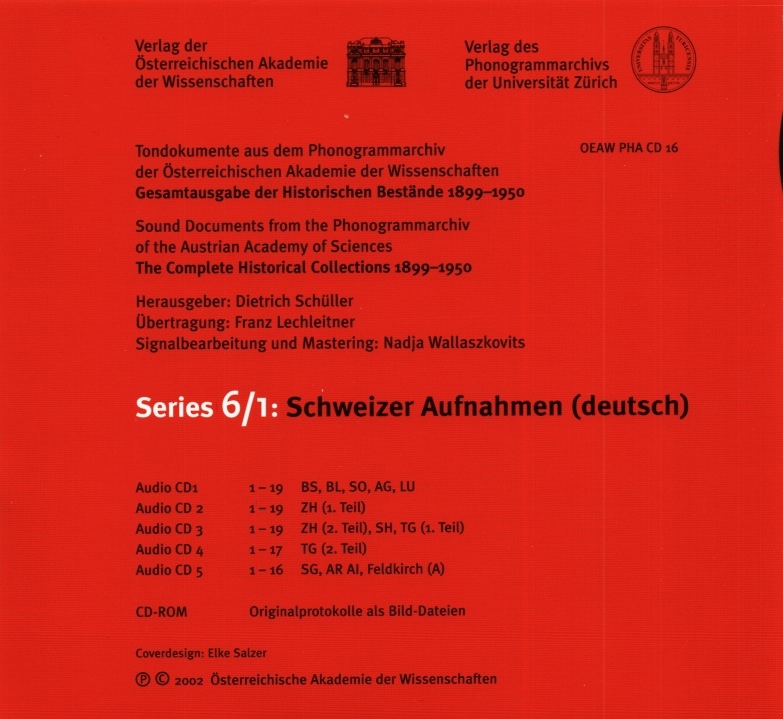
Series 6/1 (CD back cover)
-
Series 6/2 (CD front cover)
-
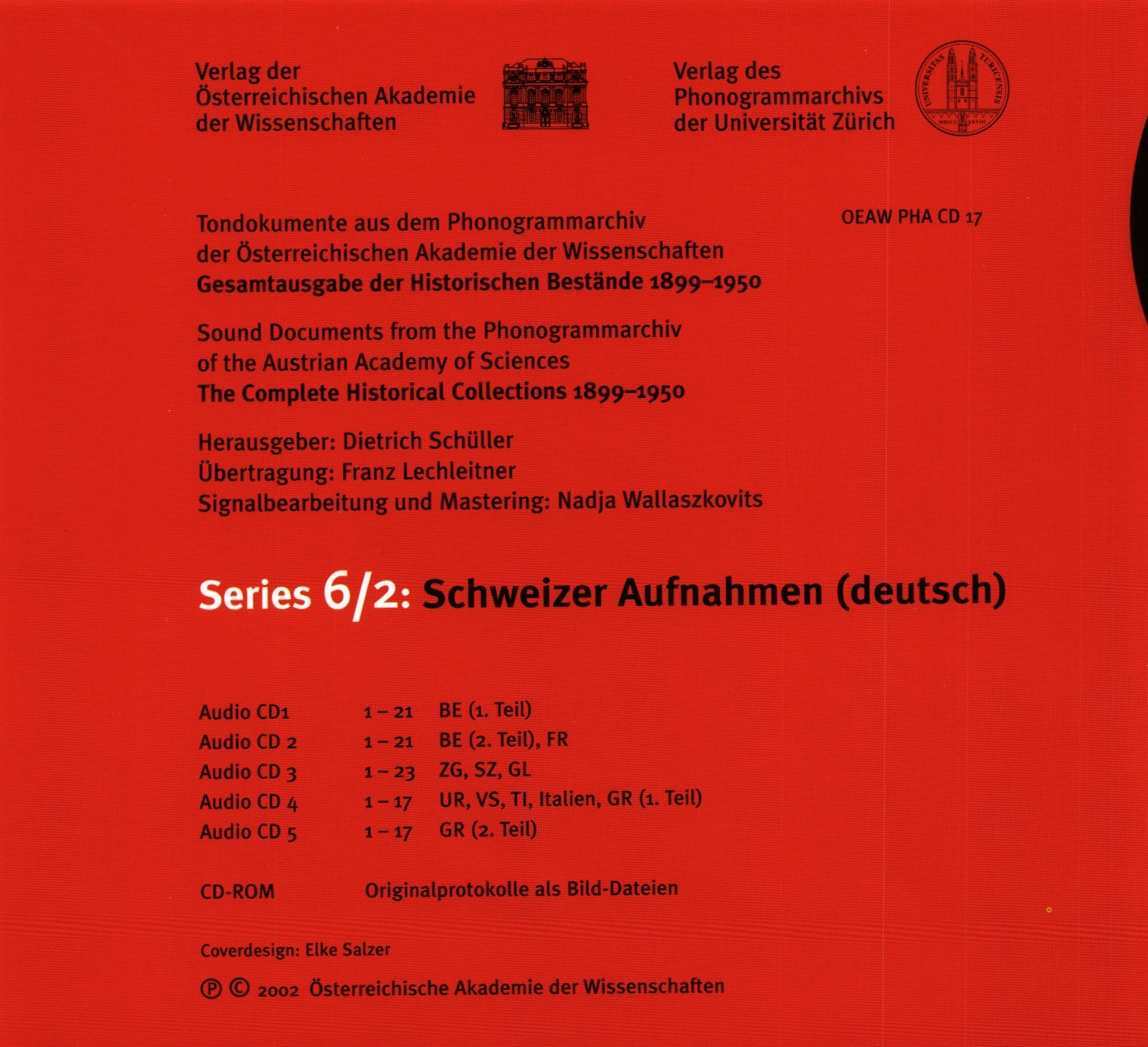
Series 6/2 (CD back cover)
-
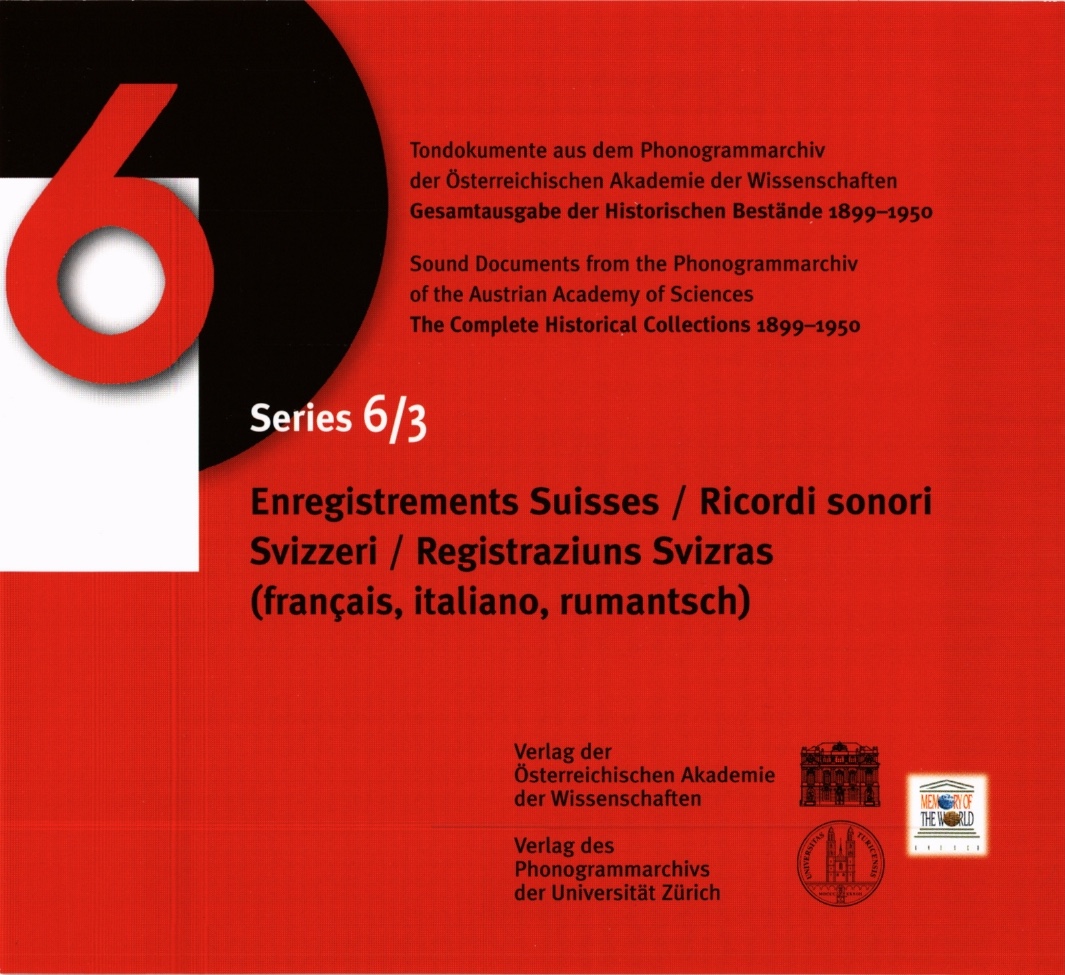
Series 6/3 (CD front cover)
-
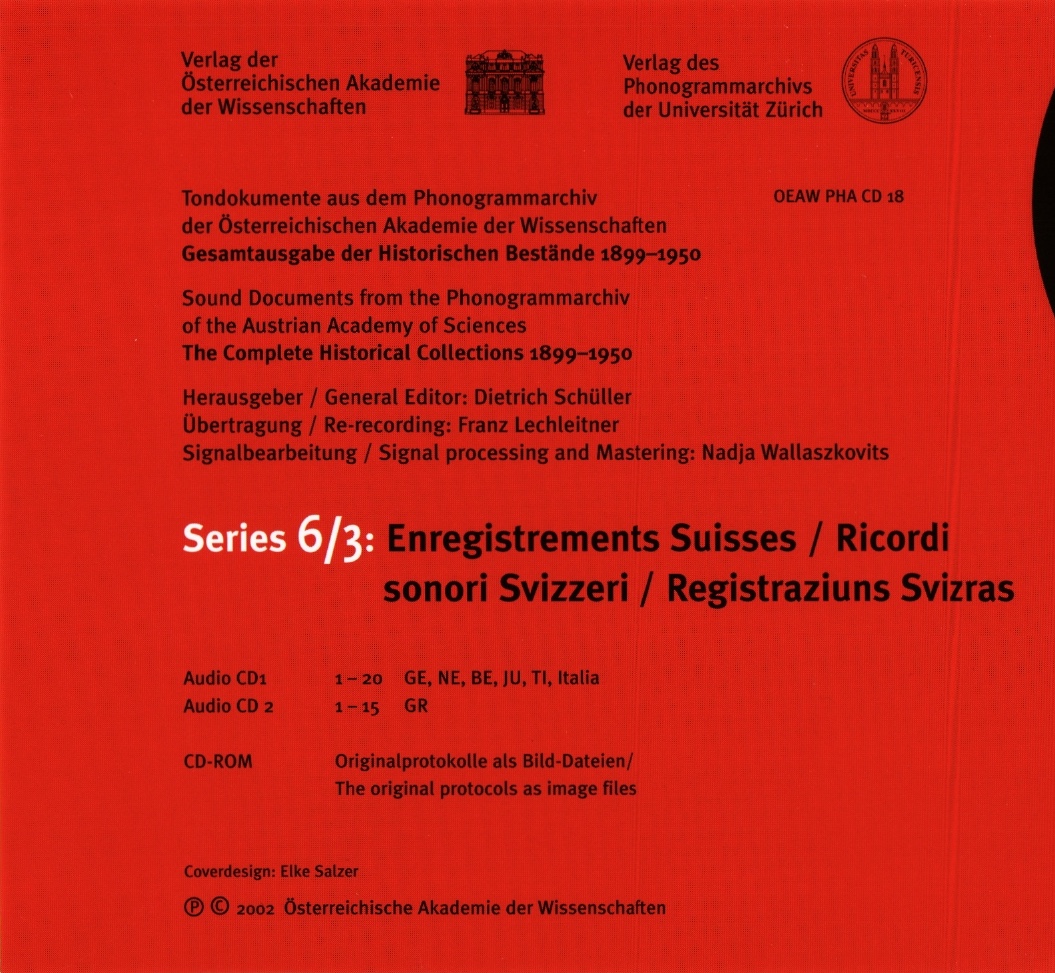
Series 6/3 (CD back cover)
-
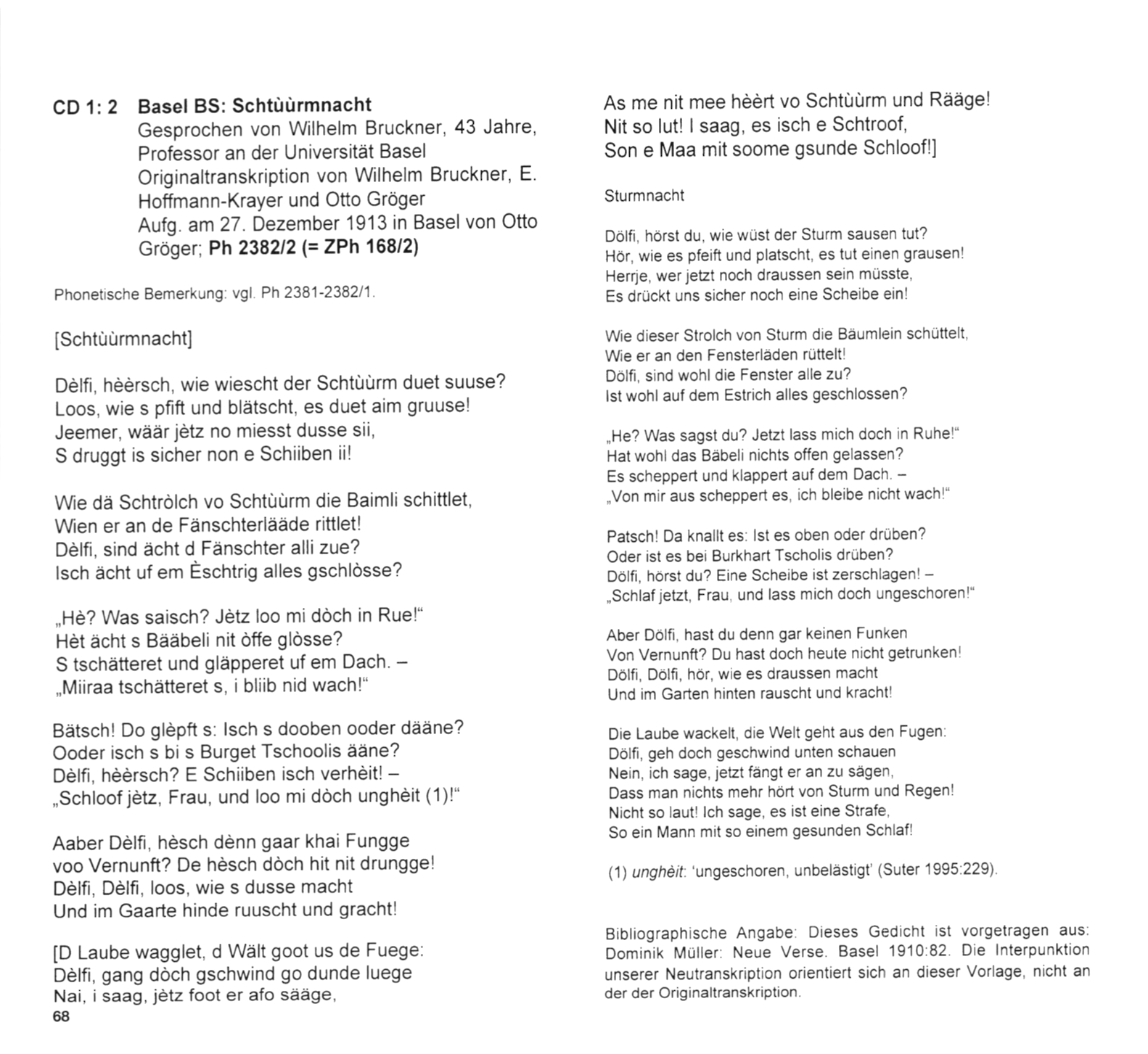
The complete transcription of the German audio sample from Basel.
-
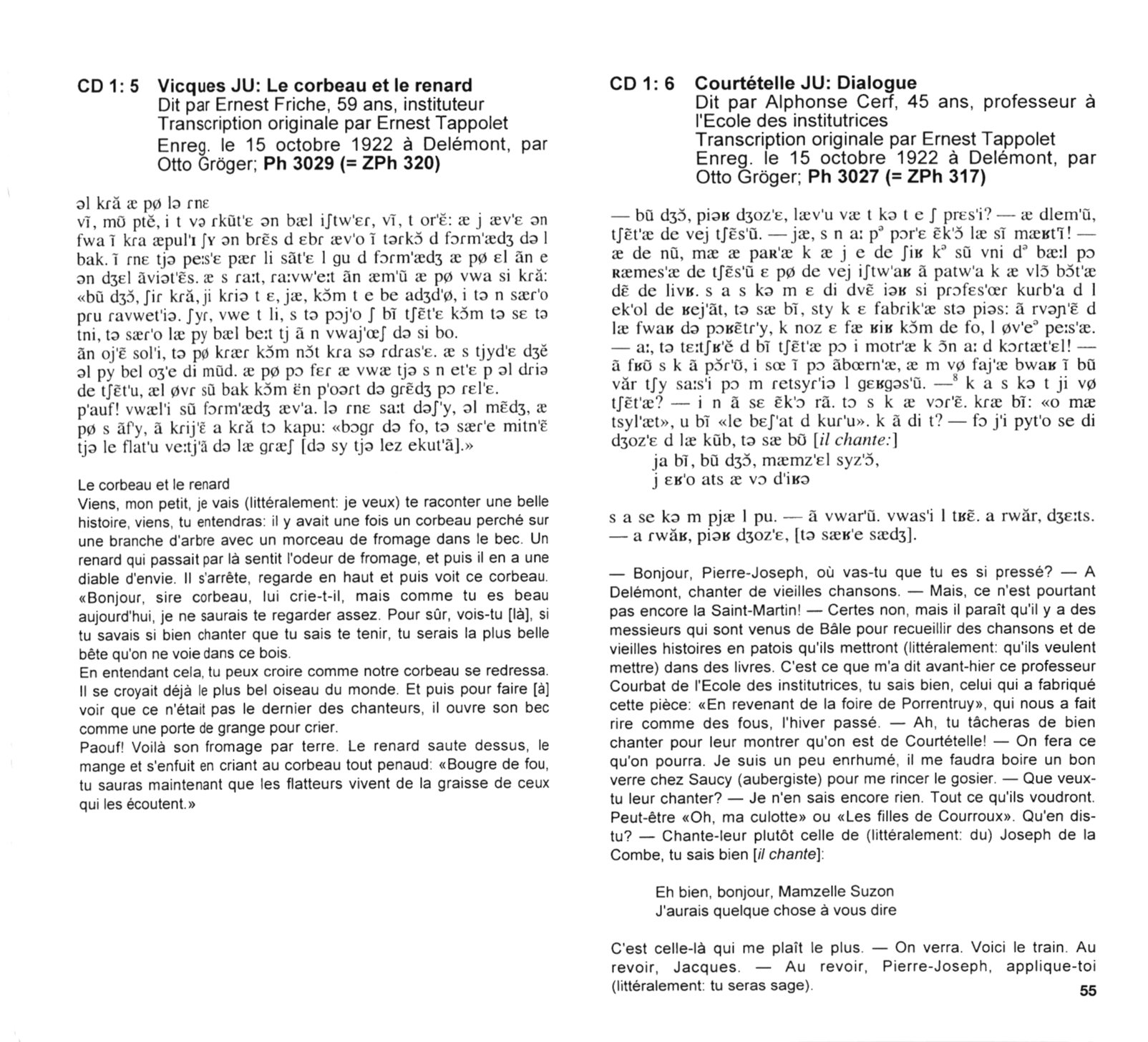
The complete transcription of the audio sample in Patois from Vicques.
-
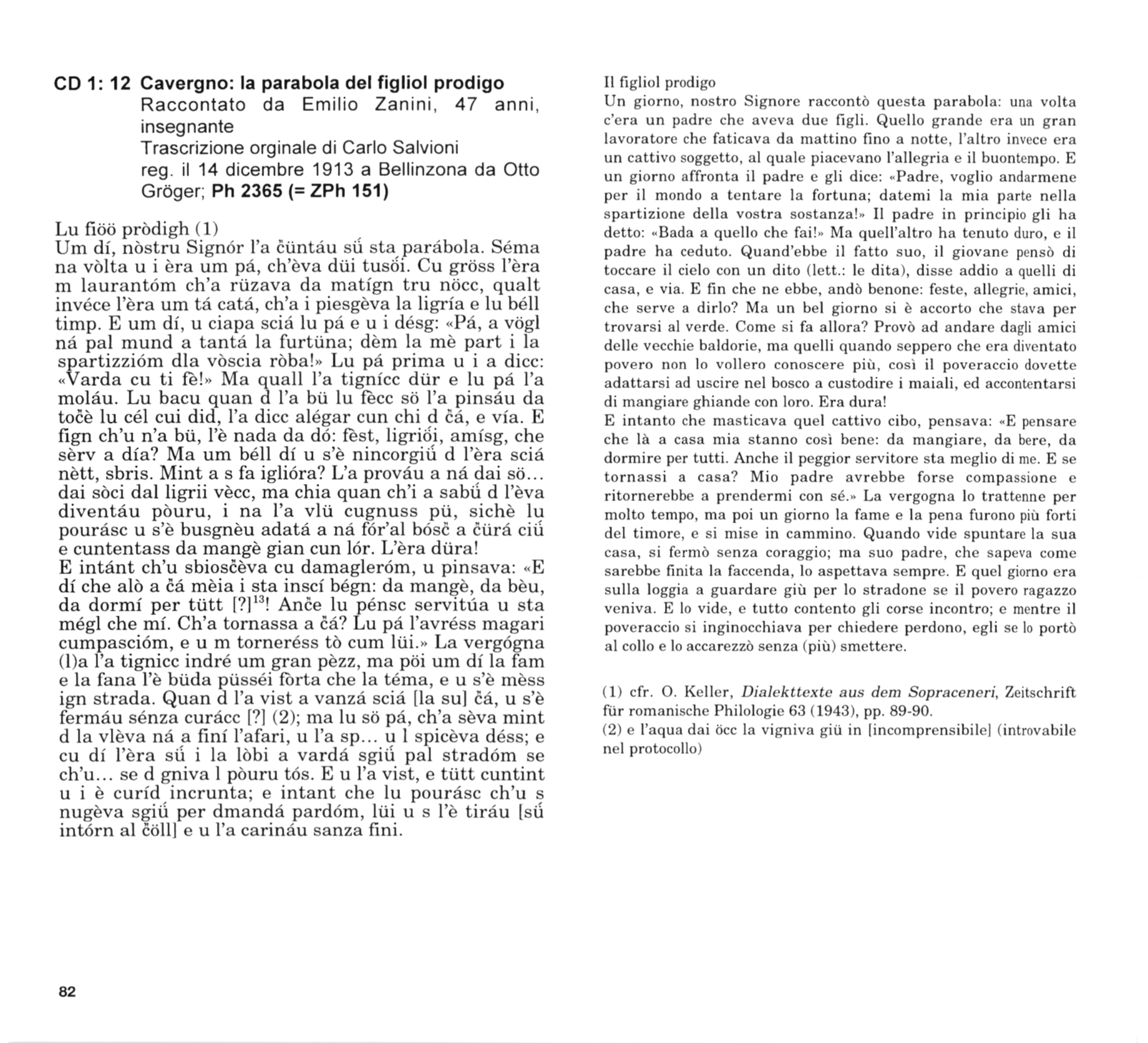
The complete transcription of the Italian audio sample from Cavergno.
-
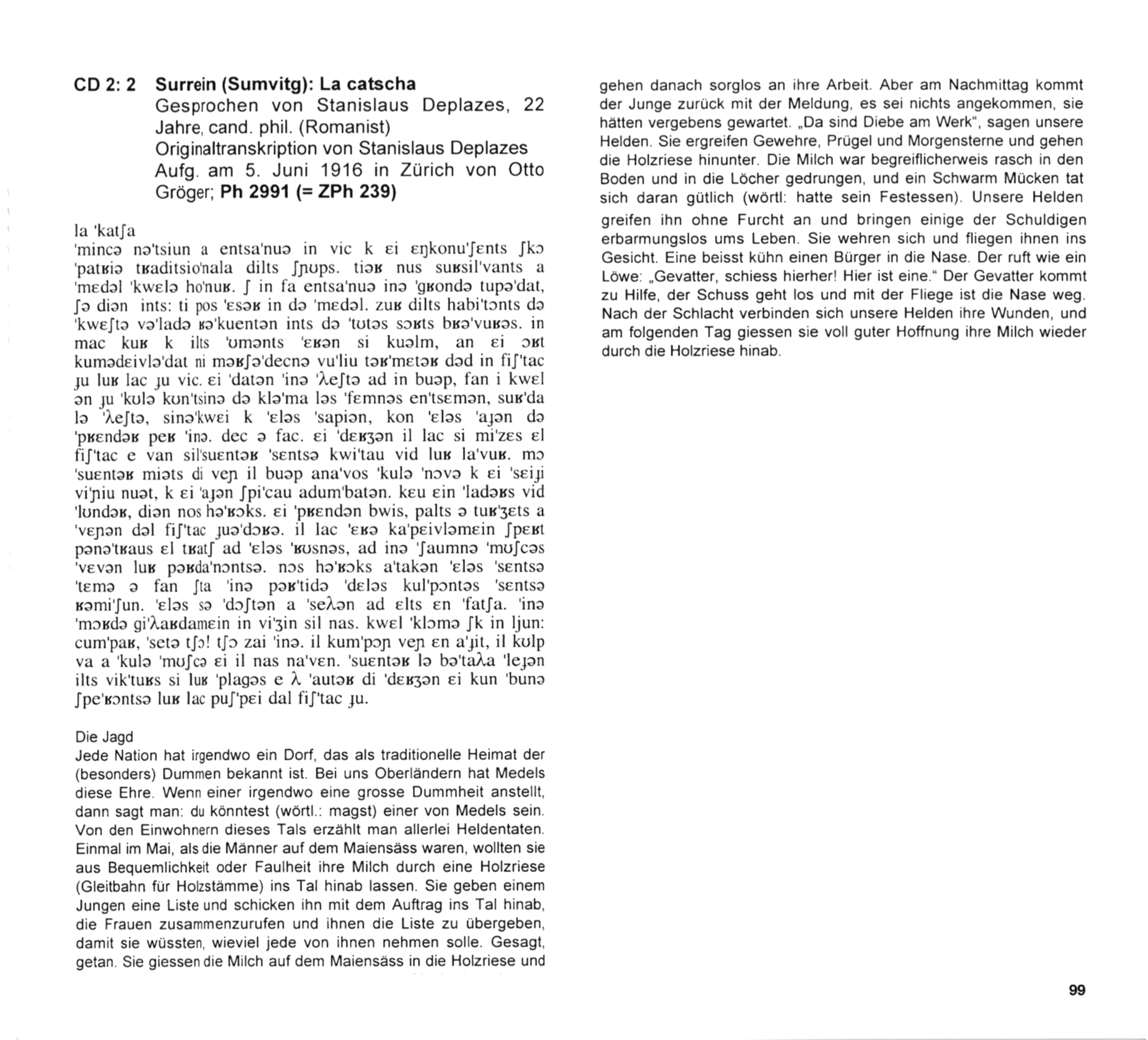
The complete transcription of the Romansh audio sample from Surrein-Sumvitg.
Audio sample Basel BS
Track: CD 1:2 "Schtùùrmnacht"
Recording date: 27 December 1913
Speaker: Wilhelm Bruckner, 43 years old, professor at the University of Basel
Transcription in dialect
Dèlfi, hèèrsch, wie wiescht der Schtùùrm duet suuse?
Loos, wie s pfift und blätscht, es duet aim gruuse!
Jeemer, wäär jètz no miesst dusse sii,
S druggt is sicher non e Schiiben ii!
Wie dä Schtròlch vo Schtùùrm die Baimli schittlet,
Wien er an de Fänschterlääde rittlet!
Dèlfi, sind ächt d Fänschter alli zue?
Isch ächt uf em Èschtrig alles gschlòsse?
Standard German translation
Dölfi, hörst du, wie wüst der Sturm sausen tut?
Hör, wie es pfeift und platscht, es tut einen grausen!
Herrje, wer jetzt noch draussen sein müsste,
Es drückt uns sicher noch eine Scheibe ein!
Wie dieser Strolch von Sturm die Bäumlein schüttelt,
Wie er an den Fensterläden rüttelt!
Dölfi, sind wohl die Fenster alle zu?
Ist wohl auf dem Estrich alles geschlossen?
Audio sample Vicques JU
Track: CD 1:5 "Le corbeau et le renard"
Recording date: 15 October 1922
Speaker: Ernest Friche, 59 years old, teacher
Phonetic transcription
əl kɾă æ pø lə ɾnɛ
vĩ | mʊ̃ ptĕ | i t və ɾkũt'ɛ ən bæl iʃtw'ɛɾ | vĩ | t or'ɛ̃ | æ j æv'ɛ ən fwa ĩ kɾa æpul'ɪ ʃʏ ən bɾɛ̃s d ɛbɾ æv'o ĩ təɾkɔ̃ d fɔɾm'ædʒ də l bak
French translation
Le corbeau et le renard
Viens, mon petit, je vais (littéralement: je veux) te raconter une belle histoire, viens, tu entendras: il y avait une fois un corbeau perché sur une branche d'arbre avec un morceau de fromage dans le bec.
Audio sample Cavergno TI
Track: CD 1:12 "La Parabola del figliol prodigo"
Recording date: 14 December 1913
Speaker: Emilio Zanini, 47 years old, teacher
Transcription in dialect
Lu fiöö pròdigh
Um dí, nòstru Signór l'a ċüntáu sǘ sta parábola. Séma na vòlta u i èra um pá, ch'èva düi tusö́i. Cu gröss l'èra m laurantóm ch'a rüzava da matígn tru nöcc, qualt invéce l'èra um tá catá, ch’a i piesgèva la ligría e lu béll timp.
Italian translation
Il figliol prodigo
Un giorno, nostro Signore raccontò questa parabola: una volta c'era un padre che aveva due figli. Quello grande era un gran lavoratore che faticava da mattino fino a notte, l'altro invece era un cattivo soggetto, al quale piacevano l'allegria e il buontempo.
Audio sample Surrein (Sumvitg) GR
Track: CD 2:2 "La catscha"
Recording date: 5 June 1916
Speaker: Stanislaus Deplazes, 22 years old, cand. phil. (romanist linguist)
Phonetic transcription
la 'katʃa |
'mincə nə'tsiun a entsa'nuə in vic k ɛi ɛŋkonu'ʃɛnts ʃkɔ 'patʁiə tʁaditsio'nala dilts ʃɲʊps | tiəʁ nus suʁsil'vants a 'mɛdəl 'kwɛlə ho'nuʁ | ʃ in fa entsa'nuə inə 'gʁondə tupə'dat, ʃə diən ints | ti pos 'ɛsəʁ in də 'mɛdəl | zuʁ dilts habi'tɔnts də 'kwɛʃtə və'ladə ʁə'kuentən ints də 'tʊtəs sɔʁts bʁə'vuʁəs
Standard German translation
Die Jagd
Jede Nation hat irgendwo ein Dorf, das als traditionelle Heimat der (besonders) Dummen bekannt ist. Bei uns Oberländern hat Medels diese Ehre. Wenn einer irgendwo eine grosse Dummheit anstellt, dann sagt man: du könntest (wörtl.: magst) einer von Medels sein. Von den Einwohnern dieses Tals erzählt man allerlei Heldentaten.
The publication "Schweizer Aufnahmen" is available in our online shop.